Dividing Fractions
Many adults remember that when dividing by a fractions, you invert and multiply. But do you know why?
Visualizing Division
First let's look at what it means to divide using whole numbers.
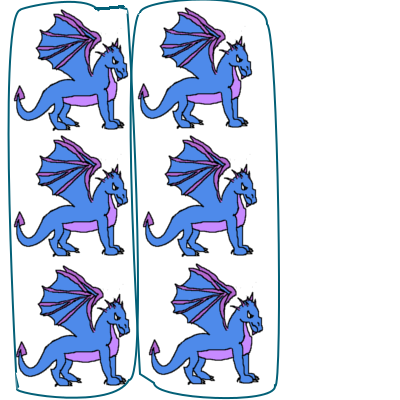
If we have a problem 6 ÷ 3, we can ask: How many 3s are there in 6?
Here are our six things:
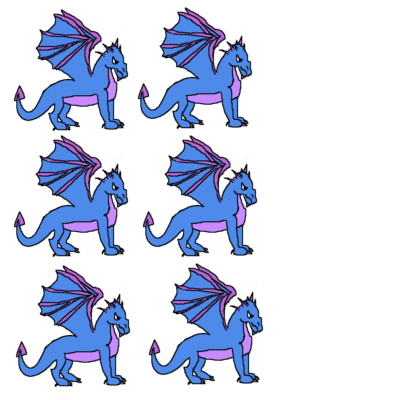
Find and circle 3 of them
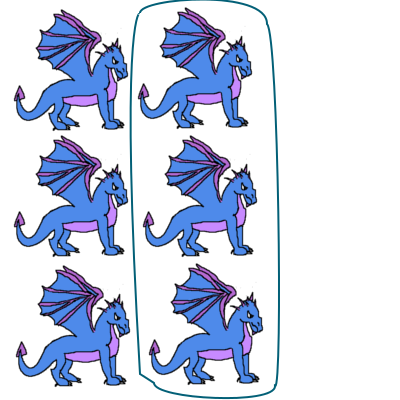
then repeat until we run out of things.
Now, with ducks, let's look at another question. 8 ÷ 4 can be the question: If we divide 8 into 4 groups, how many are in each group?
Here are the ducks 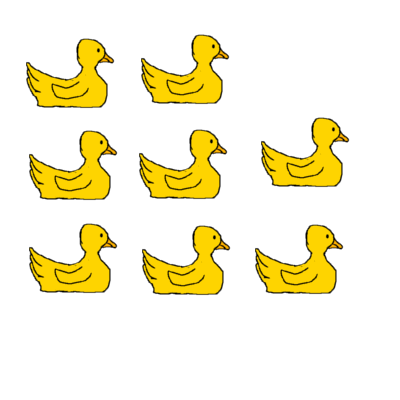
and here are four boxes to put them in  .
.
We want even groups, so put one in each box. 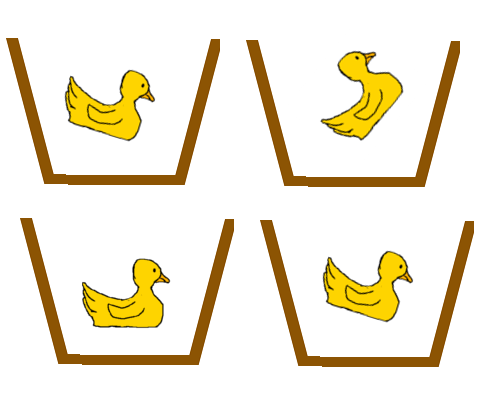 then repeat until we run out.
 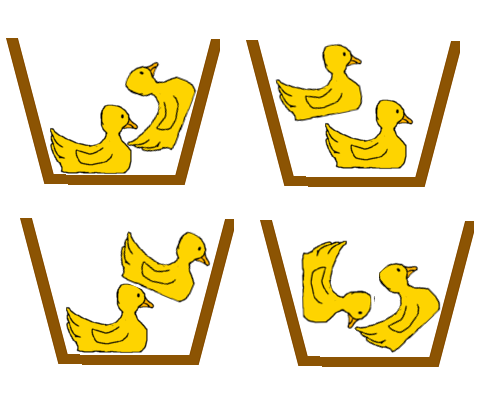 Since the groups are the same, and no ducks are left over, our answer is the number of ducks in each box: 2.
Now with Fractions
If we have 3 ÷ 1/5, we can ask How many 1/5s in 3? Or If we divide 3 into 1/5 groups, how many in each group?
Let's start with the first question. How many 1/5s in 3? Here are our 3 things:  We are looking for 1/5s, so cut each into 5 pieces.
  Each circle has 5 pieces, and there are 3 circles, so there are 3x5= 15 pieces. Because 1 has 5 1/5s in it, dividing by 1/5 becomes multiplying by 5. And so 3 ÷ 1/5 = 3 x 5 = 15.
We can instead ask: If we divide 3 into 1/5 groups, how many in each group? What is "1/5 groups"? Well, it means the three circles will be 1/5 of a larger group. Here are 3 things:  Now imagine that they are only 1/5 of something larger:
  Here are the rest of the group:
  To go from 1/5 of the group, to the whole group, multiply by 5 to get 15.